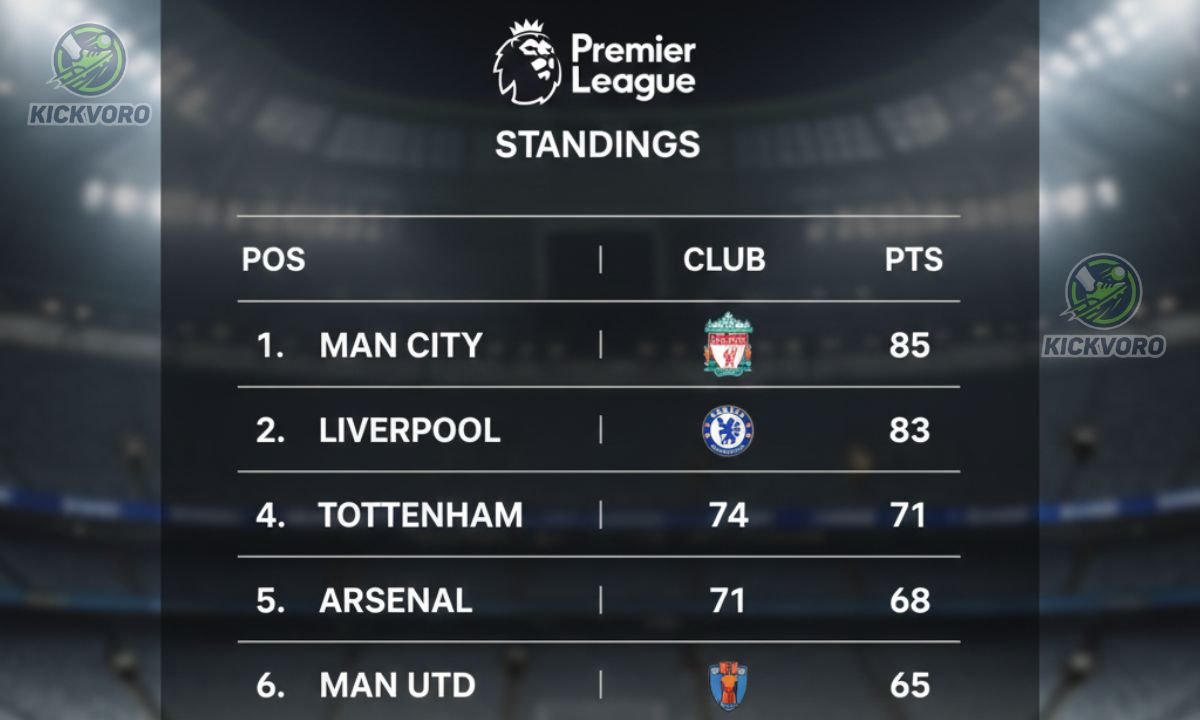
The Premier League table is sometimes viewed as a straightforward reflection of what is happening in a competition, as in who is winning and who is not. It is, however, far more than that. The Premier League table is a reflection of the teams’ momenta, pressures, and confidence levels, and at times, it is a reflection of chaos. The table changes over time to reflect the events that take a particular club in a totally opposing direction.
One thing that distinguishes the Premier League from many others around the globe is the lack of a “script.” Big teams end up dropping points when least anticipated, promoted teams can cause major surprises, and for battles to stay alive until the last moments before relegation affects certain teams. It is this element of uncertainty that has fans glued to tables every matchday.
How the Premier League Standings Are Determined
The format is quite simple. The ninety-two teams will have games against each other both at home and away. This will make a total of thirty-eight games for each club. Three points for a win, a point for a draw, and nothing for a loss. The teams will be ranked based on points earned. In case of a tie, goal difference and goals scored will come into consideration.
However, whereas simplicity resides within a system, the experience with the table proves to be anything but straightforward.
A side can be seemingly secure in its top-four place one minute and find its position precarious as soon as a couple of games go badly. The table does not lie, neither does it tell its entire tale upfront.
The Title Race at the Top
With regards to the top teams in the Premier League table, the room for error is very small. It is expected that all teams that have ambitions of winning the trophy will win matches not only against weaker opponents but also while on the road. A single draw can sometimes feel like a loss, especially where other teams are continuing to win.
What may give some teams the edge over the rest when it comes to becoming champions rather than “challengers” is not necessarily exciting displays, but the element of “control.” “Control” can be defined in terms of staying level-headed under heavy schedules, dealing effectively with injuries, and “grinding out wins.”
Another important consideration is pressure. The reality of being chased is very different from being the person who does all the chasing. Some teams deal better under pressure than others, and this is reflected in the table.
Champions League and European Cups
For those clubs not competing for the title, the race for a place within the Premier League table becomes a battle for a spot in Europe. “Qualifying for the Champions League means a world of difference to a football club’s finances.”
Such spots are normally determined by a narrow margin. Goals difference, form in head-to-head encounters, and even scoring goals at the end of the match may make a difference between regarding a season as a successful one or a less successful period. Positions in such a group are normally very close.
Even the spots for the Europa League and Conference League carry more weight than they seem at times. For some clubs, even qualification for European competition is something to celebrate and is considered an honor, even if it is not the Champions League.
Mid-Table: More Important Than You Think
The midfield of any Premier League table is said to be a “safe” place to be, though it doesn’t carry any particular significance. The teams in the midfield positions have a very important role to play in the overall story of the Premiership. They deny points to the likes of the top teams and help decide who becomes the champion in indirect title battles.
In these clubs, the position displayed shows consistency. Not struggling against relegation at an early point leaves room for experimentation and designing a future outlook. Yet, some unfortunate performances can soon put a mid-table team in danger, thus displaying how thin a line actually exists between success and failure.
Again, this section of the table is where most managerial sackings or appointments tend to occur. Clubs want to move upwards or avoid falling down.
Relegation Battle: Pressure at the Bottom
In a situation where a team is near the bottom of the league, every point is a burden. Matters of relegation can be even more intense than matters of winning a title. Losing a spot in the premiership means a tremendous loss of money, players, and even a stable future.
A Premiership team in the relegation spots might start to make many changes, such as different managers, different styles of play, and short-term fixes to their problem of relegation. The table, in this case, can easily and drastically fluctuate, especially during direct encounters for the relegating teams. One win puts them out of the bottom three, but one lost result could place them further into relegation.
The end-of-season struggle to avoid relegation is often as much about nerve as it is about talent. Those sides that keep their discipline and composure will often come through.
Home and Away Impact on Standings
One angle of the Premier League table which never gets taken into account could be home and away form. Some teams are built on a strong home record and home advantage.
Some others depend on counter-attacking football away from home, where they scoop unexpected victories. When analyzing the league tables, all these factors contribute to why particular teams move up or down in a given season.
Tough fixtures on the road could halt momentum, whereas a string of home games could accelerate a team up the table.
Injuries, Depth, and the Long Season
The Premier League is a very physical league where injuries have a significant influence on the flow of results. This is because those leagues with a deeper squad will continue to perform well regardless of injuries to key stars. However, this is not the case with other leagues.
Congestion on the fixture list during the winter and spring is another reason for this imbalance. Sides that have games in multiple competitions tend to feature many players, and these kinds of rotations sometimes tend to protect and at times disrupt the rhythm of the players.
The Reasons Behind Fan Obsession With the Standings
From the perspective of the fans, the Premier League tables are emotive. They are directly responsible for the feelings of hope, fear, and anticipation. A movement in the rankings could alter the fan spirit from positive to negative and vice versa.
Supporters also do not only look at their own position. They look at the position of rivals, future fixtures, and potential scenarios. The table becomes a source of weekly discussions, hopes, and disappointments.
Conclusion
League positions in the Premier League are far beyond what is reflected on a screen. They represent all factors that relate to being consistent and mentally strong throughout a challenging season. Starting from the title to the relegation struggle, each spot has its significance. “As the season wears on, the table tells a story that suggests something different every week. And it’s that uncertainty—the knowledge that everything can change with one result—that makes the Premier League so fascinating,” he says.




Leave a Reply