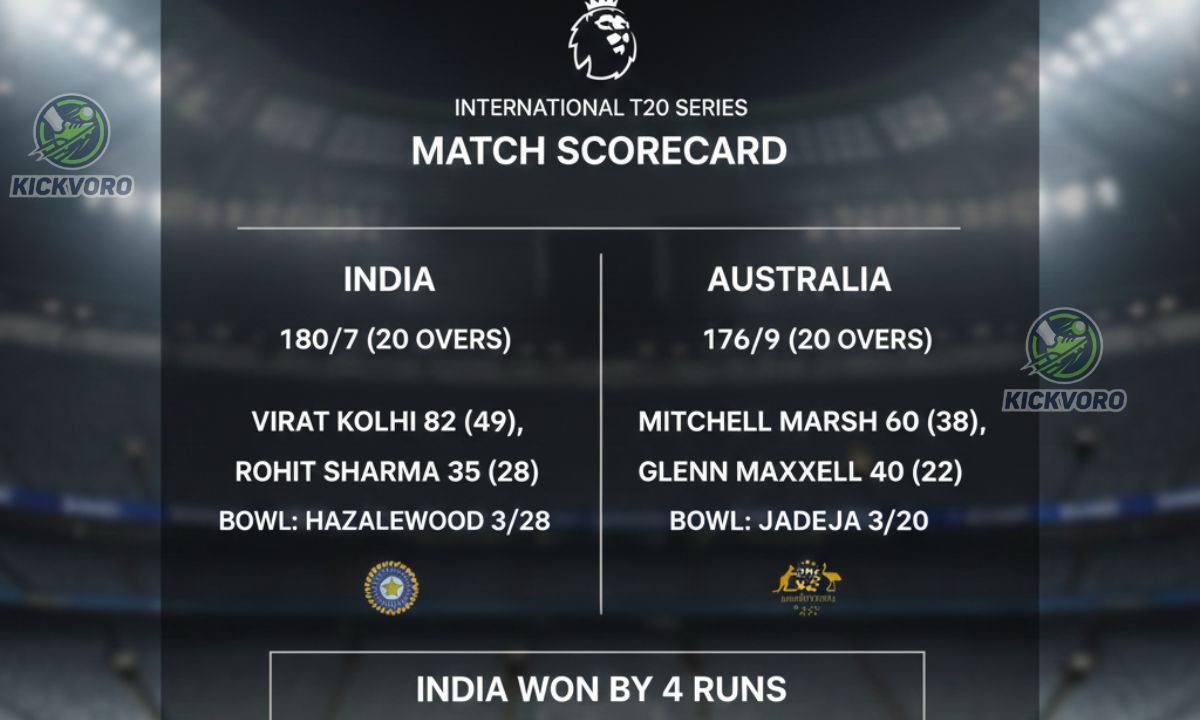
Crickets played between the Indian national cricket team and the Australian men’s cricket team have never been mere matches. These matches are one of the most heated rivalries in the cricketing world. All scores depend on the input of cricket predictions in order to gain the most possible outcome. When matches between the two teams take place, they watch the outcome and the scorecard that reflects the actual action that took place.
A scorecard transcends mere figures. It also represents moments of momentum change, pressure trials, or brilliance that commonly tip the scale for winners in showdowns between India and Australia.
First Innings: The Tone is Set
The batting team always has the intention of laying a good foundation because they are aware of the danger that the opposing team poses. In the matches between India and Australia, the partnerships formed by the opening batsmen are of utmost importance.
The scorecard might point out how well opening batsmen are able to play swing, pace, and spin balls. The role of runs scored during the power play, strikes rotated, and boundaries hit during the innings also needs to be emphasized. The role of the middle order is also important, particularly when there are swift dismissals.
From a bowler’s perspective, the result of their performance appears on the scorecard as it indicates which side dominated the inning. Economy, wickets taken during critical periods, and pressure on the batsman for a Dot Ball can be decisive as to whether a side manages to reach a decent target or not.
Middle Overs and Momentum Changes
One of the most intriguing zones of a scorecard for a India vs Australia tie would be the middle overs. These are the overs in which the momentum changes. The spinners or change bowlers start changing the game here, and the batsmen have no other option but to be cautious while charging ahead.
A cursory scan of the scorecard will reveal:
- What did happen or did not happen with regards to partnerships being
- How Run Rate was handled
- Who pressed with the ball
In contests involving these two sides, even a slightest downfall in the mid-over period can prove costly.
Effect of Death Overs on the Scorecard
The last overs make the most difference most of the time. A good end can contribute an extra 30-40 runs, which become decisive later. The scorecard shows this part of play quite evidently with massive strike rates, sixes, and swift wickets.
Death overs are a challenge for bowlers in terms of delivering. Yorker, slower balls, and length are things that are evident in statistics like economy and wicket-taking. Many IND vs AUSTRALIA encounters are remembered because of what transpired in the final overs.
Second Innings: The Chase or Defense
The second innings’ scorecard depicts a totally different scenario based on whether the team needs to chase or defend their target. In case of India and Australia being on the chasing side, the required run rate becomes a much-discussed topic.
Early wickets falling during the pursuit may cause pressure on the batting team at that very moment. Conversely, partnering well at the opening might ease the situation somewhat. This is revealed by the scorecard, which depicts the change in the batting strategy according to whether the target is moving closer or drifting away.
In defensive bowling, bowlers prefer control over aggression. Dot balls, tight overs, and wickets taken at intervals are clearly identifiable from bowling statistics.
Key Performers Highlighted in the Scorecard
Every India versus Australia match features remarkable performances. The highlights mentioned in the scorecard are:
- Leading run-scorers and strike rates
- Bowlers with match-changing spells
- Performances that help in both innings
At times, an innings or even a bowling spell can turn the whole match around. The scores are preserved even when the match is over.
What the Scorecard Really Tells Us
Alongside the end result, “Match Scorecard—How The Result Was Won/Lost” clarifies how a match has been won or lost. It reveals whether it has been a batsmen’s pitch or a bowler’s pitch, how well teams have performed under pressure, and how players have performed under pressure as well.
Starc and Warner, in a high-stakes battle similar to the one that could erupt in the Indian-Australian contest, might analyze the scorecard to find ways in which the match was turned around.
Conclusion
The scorecard between the India national cricket team and Australian men’s cricket team is more than a summary of a series of runs and dismissals. The scorecard is a reflection of strategies, hard work, and pressures faced in a game. Every score represents a moment in a game contributing to the ultimate result. Whether it is a pulsating chase, a dominant display of bowling, or a classic display of batting, it is only the scorecard which will give a true reflection of what exactly went down on the field in this legendary cricket rivalry.




Leave a Reply